 on Facebook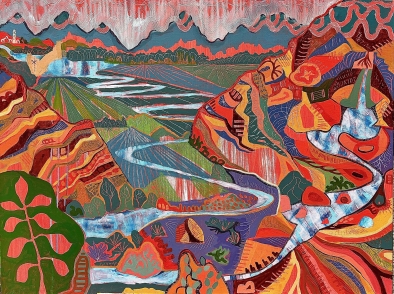
Art and ancestors and that feeling of “this is IT”
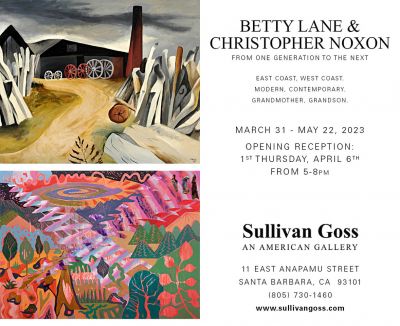
Written for a monograph to accompany exhibit showing at Sullivan Goss Gallery in Santa Barbara, through May 22: “Betty Lane and Christopher Noxon: From One Generation to the Next”:
—-
Betty Lane is my favorite artist. Of course she is - my whole idea of what an artist is and does was formed growing up looking at her pictures and visiting her little A-frame house in the woods of Cape Cod. She was witchy, stylish, a near-mythic figure representative of worlds far removed from where I grew up in sunny, showbiz-adjacent LA. She played viola in a classical quartet, wore necklaces fashioned from eucalyptus pods and sent my sister Marti and me rambling, weirdly adult letters in a scrawl that only my dad could decipher.
And she’s the main reason I make art today.
How that happened is complicated - I came to painting in midlife, twenty-odd years after she died, and when I think back over our times together I can only remember once when she directly encouraged me. When I was seven or eight I made what I called a “busy picture,” with jagged orange mountains and a spotted green sky and the remainder of the page jigsawed with trees and bushes and roads and horses and, curiously, an entire city with skyscrapers the same scale as the bushes.
I remember her seeing it and grinning, clasping her hands in front of her face, heavy rings clanking together. Then she put my busy picture in a frame and hung it up in her house, right alongside the “real art.” (It’s not lost on me that the work I’m doing today looks an awful like that busy picture - so much for growing up!)
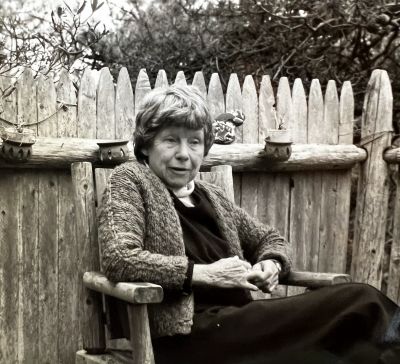
My memories of her will always be tied up in that house. You entered from the basement, where she did most of her work. Bits of colored glass hung in the window. A stuffed dinosaur sat on the chair for models. Everywhere there were paintings, stack upon stack, many on both sides of a single sheet of particle board.
Upstairs, the wooden skeleton of a pterodactyl spun slowly over a rollout desk stuffed with letters and postcards. Shelf tops were crammed with a crazy assortment of stuff—a chunk of mosaic, a swath of fishing net, a patchwork pillow, a model of a double decker bus, the inner workings of a music box. She didn’t keep these things as ornaments—she seemed to carry on a relationship with even the littlest of objects, and most gave her real pleasure. A few did not—I remember a compact disc by Bobby McFerrin had been marked with a piece of masking tape, printed with the words, “No! No!” (“Don’t Worry Be Happy” was not Grandbetty’s jam).
By the time I moved to the Cape in 1992, Betty had stopped making art. Her hands jittered, she said. She was past 80, rail thin and fiercely independent. She still tore around in her little Accord, a string of fading yarn tied to the antenna, a sticker for Michael Dukakis’ failed presidential bid on the bumper. She walked with a stoop and had a hard time getting up from a chair, but her eyesight was perfect—she took great pleasure playing a video of her cataract operation. “My eye!” she giggled, pointing at the television picture of a quivering pink glob.
I visited her on my days off work. She always made a fuss at first, shuffling around the house fetching things. A peanut butter jar filled with old raisins. A ceramic dish filled with unsalted peanuts. Cold white wine in a shrimp cocktail glass. We would talk local politics, the new New Yorker, the threat of snow.
She died a few years after I’d moved away. My father Nick and his wife Nicky helped organize an exhibit at the Cape Cod Museum of Fine Arts; family flew in for the show. In the following years Nick took on the job of sorting through her art, diaries and ephemera, assembling a biography made up mostly of her extraordinary diary entries and promoting her work in ways she was either too proud or shy to do herself.
It’s moving to think of my dad poring over all this material, filling stacks of legal pads with notes on her paintings and chapters of her life, including a frank, brutal account of her pregnancy, the chilly and mostly distant relationship with Nick’s father and various tortured, passionate love affairs (with a Jewish divorcé named Harry, a family friend and a man only identified as “Mr X.”)
I began looking after Betty’s paintings and papers a few years ago shortly after a big shift in my own life. I had recently moved out of LA to the small mountain town of Ojai and was dealing with the aftermath of a divorce and the sudden death of my eldest son.
Grieving is exhausting and infuriating - the feelings rage, the voices in your head run on repeat and everything seems to hit a dead end (he’s gone, she’s gone, they’re gone, you’ll be dead soon too…). While I had no formal training, I took up painting, holing up in a studio tucked in a grove of olive trees. Art offered an escape from the doom loop, a place where I didn’t really know who was doing the work, where the best I could do was get out of the way and let whatever needed to come arrive. I painted to get lost, to lose myself, to connect with something bigger and beyond me.
And Betty was my teacher. Early on I did a series of pictures modeled on hers, pairing portraits she’d done of subjects from the 60s and 70s beside pictures of my Ojai friends and neighbors and looking at Betty’s landscapes of Canada and Cape Cod while working on my own pictures of the landforms and skies I saw on walks near my new home.
As inspiring as her work was, Betty’s a tough teacher. She went through so many stages, so many modes, from gloomy surrealism to moddish satire. She was obviously a modern artist, but she wasn’t interested in categories like surreal, expressionist, primitive, writing at one point that “the more I work the less important style seems, the less essential. One is either good, and has it, or one hasn’t. Style is only the means.”
That’s a tough lesson for someone starting out - either you’re good or you’re not. But elsewhere in the diaries I found more encouraging ideas. In 1942 Betty was living in rural Canada, raising my dad and occasionally venturing out into the countryside to paint. She described a trip into the sand dunes of southeast Ontario:
There is a beautiful Petrified Forest of dead and somewhat submerged cedar trees. I walked towards this in pure delight feeling that indefinable, this-is-it feeling….I have been here before. There it is, clean and dead and still there, and one cannot not paint it.
That’s how it is - you see something, some particular combination of things, some brilliant scene of light or color or form and you feel deep down in your bones: one cannot not paint it. What Betty is describing - the this is it feeling - is the mysterious act of art, the verb not the noun, the aligning of an interior unknowingness and an external sensory reality, the transcendent sense of YESness, or order and harmony and congruence: THIS IS IT.
I struggle with the words to describe how good it feels to have my first real show alongside Betty, how it connects me to her and my dad and also Charlie, whose presence and absence was such a powerful force in the creation of these pictures. I don’t understand how these static, two-dimensional rectangular depictions have this power, a kind of mysterious charge that electrifies the connective threads between the here and there, the living and the dead, the seen and unseen, the known and not.
Back in 1936, Betty wrote the following in her diary:
“I am no intellectual and no genius, but I am capable of experience, and I am still discovering things which make me feel alive, so that you others may shout your heads off about this theory and that. With me, life is going on, and nothing else matters.”
That’s why Betty painted, and I why I do too.
But what does it MEAN?
A confession: I’m at a loss when it comes to art talk. Which is weird - I spent a career working as a journalist and author and while I only started painting seriously three years ago, I feel like I shouldn’t have any problem putting my work in words, or appreciating and fully comprehending writing about art.
Nope. I get clammy and tongue-tied describing why I paint what I paint, where it “comes from,” and what I love in the work of artists I revere. Meanwhile most writing about art leaves me baffled and confused and vaguely annoyed.
During a recent trip to a contemporary art museum, for example, my daughter and I entered an entirely empty room with only a faint scent of… what? Was it air freshener? A wall label had a long paragraph that ended with this sentence:
“With its invisibility, this sculpture of odors lacks materiality and captures the nature of the painting to convey an olfactory memory.”
Leaving aside my feelings about this particular piece – which, with its “invisibility” and “lack of materiality,” hit me like the height of fancy-pants hokum – I was stuck by this peak example of offputting, gobbledegook art talk. Maybe, as my artist friends tell me, it’s a coded language used by gallerists and dealers to justify value for the highfalutin academic crowd.
Or maybe it’s just like my daughter put it: “Word salad.”
Of course there’s a lot of great writing about art - I’ve loved discovering Jerry Saltz, the former long haul truck driver now chief critic at New York Magazine (Recent Tweet: “Do not ask what a work of art means. Ask what a work of art does to you. Art is not a thing, or a noun. Art is a verb. Art is something that does something to you.”) And a few months ago I was fortunate enough to be reviewed by the art critic for the LA Weekly, who wrote that my “riotously chromatic, time- and space-bending canvases seek the energy of the landscape’s wild places, infused with the pluripotentiality of the mind’s eye… Noxon’s investigations in form and color mirror the adventures unfolding in his consciousness - and the persistent sense that everything is alive and fundamentally connected, even beyond what our eyes can see.”
Wow, right? I had to look up “pluripotentiality” (defined as the “ability to develop in any one of several different ways, or to affect more than one organ or tissue”) but I was grateful for the new word – and in deploying her arsenal of art theoretics, she identified something in my pictures that I hadn’t known consciously but is unmistakably there.
Meanwhile in my studio when people come to visit – and I’ll be open March 11 all day as part of the Ojai Studio Artists Second Saturday program, come by! – I’m still mostly tongue-tied when asked about a painting. I can handle the most common questions: where is that? What kind of paint are you using? But I’m totally unhelpful when it comes to the question: what does it MEAN?
Sometimes I’ll start out with an idea in mind - about the interconnectedness of nature or the way landscapes have been historically used as promotion in the exploitation or settling of wild lands. But then the tools take over, the paint starts moving and honestly I’m not thinking at all. Painting for me is a feeling, an experience, a devotional practice that exists way beyond words.
So I guess my only answer to the question of what does it mean is another question:
How does it make you feel?
So I’ll keep feeling and studying and hoping that over time, the work leads me to more new places and even some better words to describe it.